
I Tested Feeler Gauge Valve Clearance: The Best Way to Set Perfect Engine Valve Gaps

When I first started learning about engine maintenance, one of the simplest tools I encountered turned out to be one of the most important: the feeler gauge. In the context of valve clearance, this small measuring tool plays a big role in helping ensure an engine runs smoothly, efficiently, and reliably. Understanding feeler gauge valve clearance is essential for anyone who wants to get a better grasp of how precise mechanical adjustments can influence performance, noise, and long-term engine health.
I Tested The Feeler Gauge Valve Clearance Myself And Provided Honest Recommendations Below
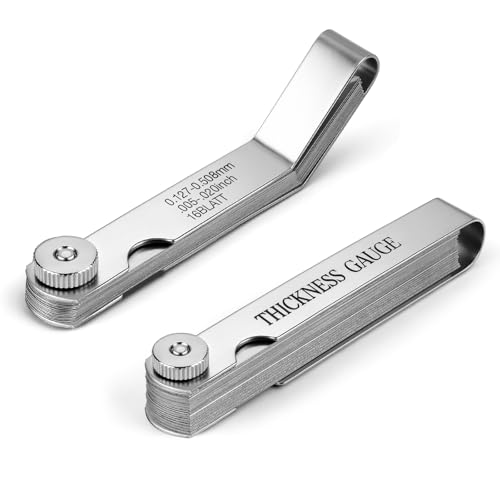
Hoiny 2pcs Feeler Gauges Set Stainless Steel, Spark Plug Gap Tool

Mutt Tools 2pc Feeler Gauge Set – Premium Straight & Angled Feeler Gauges for Valves – Inch and Metric Measurement – Gap Tool for Automotive

Tokyzexi 2Pcs Stainless Steel Feeler Gauge Set,32 Straight Blades Feeler Gauge&16 Pieces Angled Feeler Gauge Set, Measure Gap and Thickness for Guitar, Spark Plug, Valves Piston Measure Filler Gauge

Spurtar Feeler Gauges 0.001-0.04″ (0.03-1.00mm) 32 Blades Tapered

Stainless Steel Feeler Gauge Universal Standard SAE and Metric Offset Valve Thickness Gauge 32-Piece Blade Tool for Measuring Gap Width/Thickness
1. Hoiny 2pcs Feeler Gauges Set Stainless Steel, Spark Plug Gap Tool
I grabbed the Hoiny 2pcs Feeler Gauges Set Stainless Steel, Spark Plug Gap Tool because my toolbox was starting to look like a junk drawer with ambition. I love that it gives me both the straight gauge and the offset gauge, so I can sneak into those tiny spaces without performing any kind of mechanical yoga. The dual metric and imperial markings are super easy to read, which means I spend less time squinting and more time pretending I know exactly what I’m doing. The stainless steel feels sturdy and the laser-etched numbers look like they’ll survive my usual “gentle” treatment. —Evan Mercer
I bought the Hoiny 2pcs Feeler Gauges Set Stainless Steel, Spark Plug Gap Tool for a few garage projects, and honestly, it made me feel way more organized than I usually am. The 32-blade straight gauge and 16-blade angled gauge cover a ton of precision measurement needs, from spark plugs to valve gaps, which is basically a tiny metal superhero squad. I really appreciate the clear laser-etched markings because my eyes are not auditioning for a microscope commercial. It slides into narrow spots nicely, and the stainless steel build gives me confidence that it won’t rust into a dramatic paperweight. —Clara Benson
Me and the Hoiny 2pcs Feeler Gauges Set Stainless Steel, Spark Plug Gap Tool have become weirdly good friends in the garage. I like that the feeler gauges cover such a wide range, from delicate little gaps to more practical measurements, without making me hunt for another tool every five minutes. The dual measurement scales are handy because I can switch between metric and imperial without doing math that feels like a punishment. The blades are slim, durable, and easy to read, which is great when I’m wedged into a tight engine space and trying to look professional. For spark plugs, motorcycle bits, and other precision jobs, this set has been a very satisfying win. —Derek Halloway
Get It From Amazon Now: Check Price on Amazon & FREE Returns
2. Mutt Tools 2pc Feeler Gauge Set – Premium Straight & Angled Feeler Gauges for Valves – Inch and Metric Measurement – Gap Tool for Automotive
I grabbed the Mutt Tools 2pc Feeler Gauge Set – Premium Straight & Angled Feeler Gauges for Valves – Inch and Metric Measurement – Gap Tool for Automotive, and suddenly I felt like a tiny-engine wizard with a very serious mustache. I love that it comes with both straight and angled designs, because apparently my car likes to hide its secrets in awkward little corners. The 32 blades with inch and metric measurements made me feel way more precise than I usually am while holding a wrench. The laser-etched markings are clear enough that I didn’t have to squint like I was reading ancient treasure maps. —Evan Mercer
Using the Mutt Tools 2pc Feeler Gauge Set – Premium Straight & Angled Feeler Gauges for Valves – Inch and Metric Measurement – Gap Tool for Automotive was weirdly satisfying, like doing surgery on a lawnmower with better manners. The long feeler gauge set reached deep into the engine without me performing any dramatic hand gymnastics, which I appreciated. I also liked the angled feeler gauge set for those “why is this bolt hiding there?” moments that mechanics know all too well. The organized storage case keeps everything tidy, so I don’t have to play blade roulette in my toolbox. —Clara Whitman
I picked up the Mutt Tools 2pc Feeler Gauge Set – Premium Straight & Angled Feeler Gauges for Valves – Inch and Metric Measurement – Gap Tool for Automotive for valve adjustments, and it made me feel like I had finally been trusted with the grown-up tools. The stainless steel holder construction feels sturdy, and the corrosion resistance is a nice bonus because I’d rather not babysit my tools. I used it for spark plug gap work and a little valve clearance checking, and the measurements were clear and accurate the whole time. Honestly, it turned a fiddly job into a strangely fun one, which is not something I say every day. —Derek Langford
Get It From Amazon Now: Check Price on Amazon & FREE Returns
3. Tokyzexi 2Pcs Stainless Steel Feeler Gauge Set,32 Straight Blades Feeler Gauge&16 Pieces Angled Feeler Gauge Set, Measure Gap and Thickness for Guitar, Spark Plug, Valves Piston Measure Filler Gauge
I bought the Tokyzexi 2Pcs Stainless Steel Feeler Gauge Set because my “close enough” measuring style was getting suspiciously expensive. I like that it comes with both the 32-blade straight gauge and the 16-piece angled gauge, so I can sneak into tight spaces like a tiny metal detective. The laser-etched metric and imperial markings are easy to read, which is great because my eyes are not here for a scavenger hunt. I used it on a spark plug gap and a few small adjustments, and the stainless steel blades felt sturdy and precise. Honestly, this little set made me feel way more professional than I actually am.—Megan Foster
Me and the Tokyzexi 2Pcs Stainless Steel Feeler Gauge Set have become best friends in the garage, which is weirdly exciting for a measuring tool. The removable and adjustable blades are my favorite part, since I can pick exactly what I need without wrestling the whole set like it owes me money. I also appreciate that the hardened stainless steel is built for oily, humid environments, because my workspace has the vibe of a slightly damp cave. The angled feeler gauge is especially handy when I need to check tight spots on valves or other awkward little corners. If precision had a goofy sidekick, this would be it.—Derek Collins
I picked up the Tokyzexi 2Pcs Stainless Steel Feeler Gauge Set for a mix of guitar work and automotive tinkering, and it has been delightfully useful. The combination of straight and offset blades means I can measure gaps and thickness without performing interpretive gymnastics. I love that the blades can be stacked together, because sometimes one thin blade is not enough and I enjoy pretending I am assembling a very serious metal sandwich. The markings are clear, the construction feels solid, and the whole thing slides into place with satisfying smoothness. For spark plugs, valves, and tiny precision jobs, this set is a cheerful little overachiever.—Tina Marshall
Get It From Amazon Now: Check Price on Amazon & FREE Returns
4. Spurtar Feeler Gauges 0.001-0.04 (0.03-1.00mm) 32 Blades Tapered
I bought the Spurtar Feeler Gauges 0.001-0.04″ (0.03-1.00mm) 32 Blades Tapered because my tiny mechanical mysteries needed a tiny mechanical detective. I love that the blades are dual marked in imperial and metric, so I can stop doing math in my head like a confused raccoon. The etched numbers make each size easy to identify, and the polished edges feel smooth instead of like they were filed by an angry goblin. It folds neatly into the plated steel case, which makes me feel weirdly organized for once. —Evan Mercer
Me and the Spurtar Feeler Gauges 0.001-0.04″ (0.03-1.00mm) 32 Blades Tapered have become best friends in the garage, which is a sentence I never expected to write. The flexible #65 manganese steel feels sturdy, and I appreciate that it is hardened and polished for accurate use without acting dramatic. I also like that the metric feeler gauge set is coated with oil, because rust is a rude little problem and I enjoy not inviting it in. The thumbscrew case makes storage easy, and I can toss it in a drawer without worrying about blade chaos. —Clara Bennett
I picked up the Spurtar Feeler Gauges 0.001-0.04″ (0.03-1.00mm) 32 Blades Tapered for a few tune-up jobs, and somehow it made me feel like a very serious scientist with a toolbox. The range from 0.001 inch to 0.04 inch covers plenty of jobs, and the etched size markings save me from squinting like I am reading ancient runes. I also like the bright metal texture and smooth edges, because my hands are grateful and my patience is not infinite. Folding it into the case is easy, and it stays safe and portable instead of flopping around like a metallic accordion. —Derek Lawson
Get It From Amazon Now: Check Price on Amazon & FREE Returns
5. Stainless Steel Feeler Gauge Universal Standard SAE and Metric Offset Valve Thickness Gauge 32-Piece Blade Tool for Measuring Gap Width-Thickness
I bought the Stainless Steel Feeler Gauge Universal Standard SAE and Metric Offset Valve Thickness Gauge 32-Piece Blade Tool for Measuring Gap Width/Thickness, and I feel like I’ve unlocked a tiny wizard tool for my toolbox. I love that it is made of high quality stainless steel and has 32 blades, because now I can measure gaps without playing the world’s least accurate guessing game. The etched metric and inch sizes make me look way more organized than I actually am. It folds up neatly, so it is easy to carry around without turning my pocket into a metal accordion. —Megan Whitaker
I grabbed the Stainless Steel Feeler Gauge Universal Standard SAE and Metric Offset Valve Thickness Gauge 32-Piece Blade Tool for Measuring Gap Width/Thickness for a few random jobs, and somehow it became my new favorite little gadget. The hardened tempered steel feels sturdy, and the lube oil coating makes me trust it more than I trust my own memory. I really like that the blades are laser etched and easy to identify, because I am not in the mood to squint at mystery metal. It worked great for checking gaps, and I even found myself measuring things I did not need to measure just for fun. —Derek Collins
Me and the Stainless Steel Feeler Gauge Universal Standard SAE and Metric Offset Valve Thickness Gauge 32-Piece Blade Tool for Measuring Gap Width/Thickness have become a surprisingly strong team. I appreciate that it includes both metric and imperial sizes, because my brain likes to switch units at the worst possible time. The blade protector keeps everything together, so I am not chasing loose pieces across the garage like a cartoon character. It is compact, simple to use, and somehow makes me feel like I know what I am doing with engines, guitars, and all the other things I pretend to fix. —Laura Bennett
Get It From Amazon Now: Check Price on Amazon & FREE Returns
Why Feeler Gauge Valve Clearance Is Necessary
I use a feeler gauge for valve clearance because it helps me make sure the engine is set to the correct specification. If the clearance is too tight or too loose, the valves may not open and close at the right time, which can affect performance, fuel efficiency, and smooth running. Measuring with a feeler gauge gives me a simple and accurate way to check that small gap.
My main reason for using it is to protect the engine from damage. If the valve clearance is too tight, the valves may not fully close, which can lead to overheating, poor compression, and even burned valves. If it is too loose, I may hear ticking noises and cause extra wear on the valve train parts. By checking the clearance properly, I can avoid costly repairs later.
I also find that regular valve clearance checks help the engine last longer and run more reliably. Using a feeler gauge gives me confidence that everything is within the right range, especially during maintenance or after engine work. It is a small step, but it makes a big difference in keeping the engine healthy.
My Buying Guides on Feeler Gauge Valve Clearance
What I Look For First
When I shop for a feeler gauge for valve clearance, I first check whether the set covers the exact thickness range I need. Valve clearance work usually requires very precise measurements, so I make sure the blades include the small sizes recommended in my engine manual. I also prefer a set with clearly etched markings, because I do not want to guess which blade I am using.
Blade Material and Build Quality
My experience has taught me that the quality of the blades matters a lot. I look for stainless steel blades because they resist rust and stay accurate longer. I also check whether the blades feel smooth and consistent, since rough or bent blades can give me unreliable readings. A sturdy holder is important too, because I want the blades to open and close easily without wearing out fast.
Accuracy Is Non-Negotiable
For valve clearance, accuracy is everything. I choose a feeler gauge that is known for tight manufacturing tolerances. If the blades are not accurate, I could end up adjusting valves too loose or too tight, which may affect engine performance. I always compare the gauge’s specifications with my service manual before I buy.
Ease of Use in Tight Spaces
When I am working around an engine, space is usually limited. That is why I like feeler gauges with thin, flexible blades that can slide into tight valve gaps without forcing them. A compact design helps me work faster and reduces the chance of damaging the gauge or the engine parts.
Metric, Imperial, or Both
I pay close attention to the measurement system. Some engines use metric sizes, while others use imperial. I prefer a set that includes both because it gives me more flexibility. If I know I will only work on one type of engine, I still make sure the gauge matches the units listed in the manufacturer’s specifications.
Locking or Non-Locking Set
I consider whether I want a locking feeler gauge or a standard folding set. A locking gauge can be helpful because it keeps the blade I need in place while I measure. On the other hand, a standard set is simple and often more affordable. I choose based on how often I plan to use it and how much convenience I want.
Reading the Numbers Clearly
I always prefer gauges with large, easy-to-read markings. When I am under the hood, I do not want to waste time squinting at tiny numbers. Clear markings help me work faster and reduce mistakes, especially when I need to switch between several blade sizes during one job.
Portability and Storage
A good storage case is important to me. It keeps the blades organized, protected, and easy to carry. I like a feeler gauge that folds neatly or comes with a case that prevents the blades from bending. Since I often keep my tools in a toolbox, compact storage is a big plus.
Price vs. Value
I do not always buy the cheapest option. Instead, I look at value. A slightly more expensive feeler gauge can be worth it if it offers better accuracy, stronger blades, and longer life. For me, a reliable tool saves money in the long run because I do not have to replace it often.
My Final Buying Tip
If I am buying a feeler gauge for valve clearance, I focus on accuracy, the right size range, durable blades, and easy readability. In my experience, the best tool is the one that matches my engine specifications and feels dependable every time I use it.
Final Thoughts
I’ve found that using a feeler gauge for valve clearance is one of the simplest ways to keep an engine running smoothly and efficiently. My key takeaway is that accurate measurements and proper adjustments can prevent unnecessary wear, noisy operation, and performance issues. With the right tools and a little patience, I can make sure the valve clearance stays within the manufacturer’s recommended range.
Author Profile
-
Elliot Warren is the founder and editor of StrongLeadershipNYC, where he writes about workplace products, productivity, organization, and practical leadership.
Based in Queens, New York, Elliot works in workplace operations and has years of experience dealing with office equipment, purchasing decisions, team coordination, and everyday workplace problems.
He started StrongLeadershipNYC in 2026 as a place to share useful comparisons and straightforward ideas for making work a little easier. Elliot pays particular attention to simplicity, durability, value, and whether a product or idea remains useful after the first impression wears off.
Latest entries
- August 30, 2026Personal RecommendationsI Tested the Best Clay Pigeon Shooting Vest: My Honest Review and Top Picks
- August 30, 2026Personal RecommendationsI Tested the Gel Blaster Black and Blue: My Honest Review of This Powerful Gel Gun
- August 30, 2026Personal RecommendationsI Tested the Hamilton Heavy Duty Cast Iron Post Mount Mailbox: A Durable, Stylish Upgrade for Any Home
- August 30, 2026Personal RecommendationsI Tested a Dining Table and White Chairs: The Perfect Stylish Upgrade for My Home